
Every serious skier knows the mountain doesn't negotiate. But what happens when the climate starts rewriting the rules of the game? Updated forecasts from NOAA and Europe's medium-range forecasting center are now signaling that a "Super El Niño" event could materialize by autumn 2026 — potentially one of the strongest ever recorded. The European model suggests Pacific Ocean temperatures could rise as much as 3°C above average, pushing this into historic territory. For skiers, this is more than just climate news. It's a direct threat and opportunity to your 2026–27 season.
What El Niño Actually Does to Snow
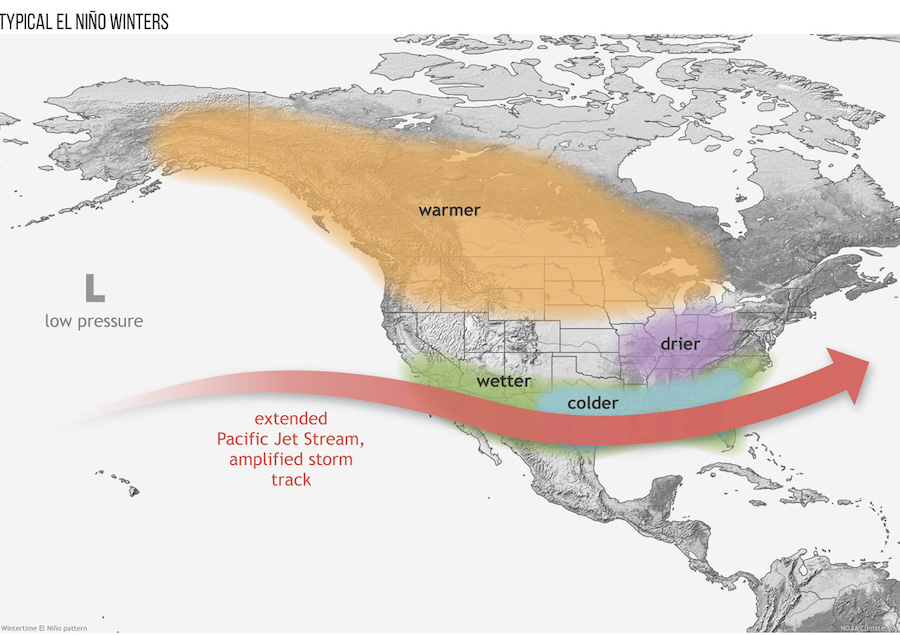
El Niño doesn't kill skiing universally. It reshapes it. Warmer El Niño temperatures lead to wetter, heavier snow — good for some conditions but also creates icy patches. These storms carry more moisture and warmth, meaning the snow that falls at lower elevations tends to be heavy and wet rather than the cold dry powder of a La Niña year. Here's what the historical data tells us:
Winners
- Sierra Nevada / California — El Niño years typically bring above-average snowpack to the Sierra. Tahoe, Mammoth, and Palisades tend to have strong seasons. Ikon Pass holders take note!
- Pacific Northwest — Generally benefits from increased precipitation, though rain/snow lines can be unpredictable at lower elevations
- Rocky Mountain South (New Mexico, southern Colorado) — Often sees above-average snow during strong El Niño winters. Think Wolf Creek, Telluride.
- Altitude is a good hedge.
Losers
- Northern Rockies (Montana, Idaho, Wyoming) — Big Sky, Jackson Hole, and Sun Valley historically underperform during strong El Niño events. Warmer, drier conditions tend to dominate.
- Northeast — Mixed picture. El Niño often brings warmer temperatures and rain events that devastate snowpack at lower elevation resorts. Probably will see a deficit of up to 10 inches of snowfall below the trailing three-decade average during moderate and strong El Niño events
- Colorado's Front Range — Tends toward a drier pattern during strong El Niño winters.
You're buying your pass now, but skiing in a Super El Niño winter.
- Northern Rockies (Montana, Idaho, Wyoming) — Big Sky, Jackson Hole, and Sun Valley historically underperform during strong El Niño events. Warmer, drier conditions tend to dominate.
- Northeast — Mixed picture. El Niño often brings warmer temperatures and rain events that devastate snowpack at lower elevation resorts. Probably will see a deficit of up to 10 inches of snowfall below the trailing three-decade average during moderate and strong El Niño events
- Colorado's Front Range — Tends toward a drier pattern during strong El Niño winters.
You're buying your pass now, but skiing in a Super El Niño winter.
Here's the strategic implication most skiers won't think about until it's too late: you're buying your pass now, but skiing in a Super El Niño winter. If the forecasts hold, the calculus shifts meaningfully: An Epic Pass optimized for Vail and Breckenridge may underperform if Colorado sees a drier winter. Although, for Utah and Colorado the predictive value of El Nino can be minimal. An Ikon Pass with Mammoth and Palisades Tahoe exposure could significantly outperform expectations. Mountain Collective holders with flexibility toward California and Pacific NW destinations may find themselves perfectly positioned. The $1,000+ pass decision you make this spring will be measured against a winter that climate scientists are already flagging as anomalous.
The Deeper Problem: We Plan for Average Winters
Most skiers budget for a typical season. Average snowfall. Average trip count. Average conditions. But skiing has never really been an average sport — and climate volatility is making that baseline increasingly unreliable. This is exactly why the Anticipate phase of your season matters more than ever. The skiers who will maximize their 2026–27 season aren't the ones who ski the most — they're the ones who plan the most intelligently: right pass, right resorts, right timing. A Super El Niño winter rewards flexibility and punishes inertia.
What LastRun Is Watching
At LastRun, we track skiing not just as a sport but as an annual wellness investment. A Super El Niño event is a stress test for that investment — and a reminder that the ROI of your season isn't just about ski days. It's about making the right decisions in the Anticipate phase so the Perform phase delivers. We'll be updating our pass guidance as the seasonal forecasts sharpen through summer. Climate science is noisy. Follow along at www.lastrun.live.